|
- Ride impressions -
GoGo steals away into the rainy mountain roads on the all new
BMW S1000RR
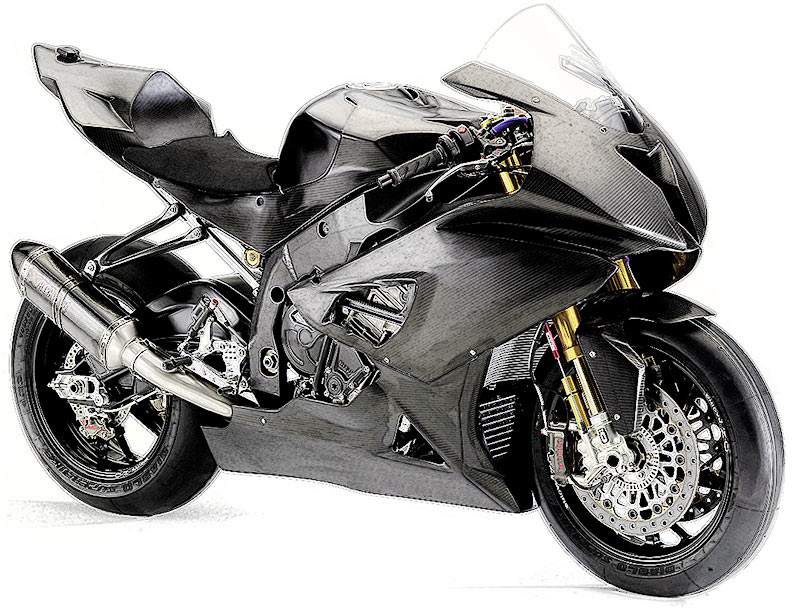
Mark my words this new BMW S1000RR will re-define the new standard for sportbikes to be measured from now into the future.
It feels not "like" a 600 underneath you, it IS a 600 underneath you. Only it's not a six hundred, it's an arm socket stretching 1000cc inline four. Right away it feels very small, very light. In fact at speed I cannot just bend forward into a tuck behind the screen, I have to move my ass back in the seat first or my visor may touch the windscreen. But I'm a nick over 6'2". Speaking of the windscreen, not great coverage. Tough to hide behind. My shoulders seemed out there more than usual. Maybe it's just me.
The bike is faster than any I have ever raced. Power comes on like you would have designed it to, had anyone at BMW ever asked.. If you can picture a dyno chart but you're not sure what graph feels like what - one with a low slope back rising up means the power's dead in the middle then hits hard at the top. One shaped with an arc like a cat about to scratch your eyes out comes on like a herd of stampeding horses not just at the top, but all the way through. The BMW comes on like stampeding horses, all the way through. At least that's how it feels, I have never seen it's chart.
There is a gyro somewhere inside this machine which monitors not only lean angle side to side, but also front to back. Apparently side to side angle is sampled constantly and this data is considered when the bike decides how much of the power you are asking for, it should give you. IE; straight up and down it will accelerate harder at full throttle than it will at full lean, to keep you from high-siding. That all sounds great, especially the fact that you can turn it off completely if you like, but I was not given the opportunity to test this system out on the street. In fact I don't expect I was given the opportunity to ride it how I did last week either, on the rain soaked mountain roads, but I rolled the dice and did anyway. And this is where things got interesting.
I'm sure everyone's got their technique for rain riding, or racing. Mine is simple - brake straight up and down real hard if needed, pre-determine your corner speed, then let go of everything with slight throttle and lean her in. Trail brake even a touch, you are done. Crack off the gas suddenly (specially on a twin) you are done. Be gentle and be smooth. So this is how I rode the BMW at first - pre-determined roll speed in a turn, no trail braking. But on the tight mountain roads that's almost impossible to do at a decent pace unless you've got the whole mountain memorized, and of course so long as nothing jumps out at you. So I struggled at first with my confidence (ever see the tires this bike comes with? Barely any tread.) until I did two things:
1 - I pulled over and put to use a fascinatingly simple but revolutionary (to me anyway) tool - the bike's key. It's got a screwdriver tip designed to be used to adjust suspension settings. What's so fascinating about that? I actually stopped mid-ride and made adjustments - something I have never done in 25 years of sport riding.. Each setting is not set by counting clicks, there is no checking notes and you don't have to zero out the adjusters counting all over again from the beginning - they are simply numbered 1-10. Both the front and rear were set on 7. I set them each to 3.
2 - I began experimenting with the anti-lock (rear) braking system. Yes we all know dragging the rear brake in a turn helps adjust your speed and tighten up your line. But in a downpour on a road covered in patches of mud, gravel, and littered with wet painted lines and leaves? I don't THINK so.
....or should I say I "didn't" think so.
With the suspension now much softer I felt more confident going into a turn, in a turn, and coming out. Much better feedback. And as I grew more confident with using the rear brake to adjust my corner speed through the sloppiness, I grew curious as to just how much you could count on BMW saving your ass if you dragged it just a little too much. Since I was on a data collecting mission, eventually I actually stood on the rear brake to intentionally lock it up while leaned over. What I discovered is BMW's anti-lock system is quite admirable. I think they should put a score board up on the dash. Rider VS BMW. And in the case of my locking the rear up over the rain soaked painted lines mid-corner, the dash might read:
I found myself fascinated, I could actually get the rear tire to lock up - but only for a split second. Just long enough for me to know I just lost a point. The bike would shutter sideways for an instant, then straighten right back up and track forward again - no matter how hard I kept standing on it. As you can imagine, out there in the soaking wet this instantly became a reliable tool in a riders arsenal of tricks.
Then I started testing the traction control. Still in the full wet (visor cracked, face dripping, snot, cold, the whole nine yards) I pinned the throttle and diagonally rode over the double painted yellow lines. Again, I have not analyzed this system on any charts, so this is a pretty raw real world seat of the pants data. Under "Rain mode" the bike accelerates like a 600. That's the biggest difference. It's very soft, gentle, almost castrated - which is exactly what you want in the rain. No sudden anything. But still it was strong enough to break the rear tire loose once I crossed the wet double yellow lines. My guess is the rear spun five to ten feet @ 50mph. Enough to let you know BMW just got another point on the dash, but not enough to cause any trouble. In "Race mode" the rear broke loose just the same, and for the same distance, it just happened earlier because the motor accelerated harder.
It is my guess then that while basically straight up and down, all modes of traction control use and process the same data the same way. Perhaps though once you're at full lean, the gyro data comes more into play and the differences between modes becomes more apparent. I don't know, it's just what I felt. I did spin the throttle pretty hard while leaned over as much as my balls would allow, in all modes of traction control, none broke the tire loose. Then I got ridiculous (still with the wet, and the snot) and punched it wide open over a rain soaked bumpy straight. Just like in the dry, the bike felt ridiculously fast in race mode. But curiously I never felt the rear tire break loose. Without traction control it surely would have. Instead in race mode the bike powered up to redline in first gear, raising the front tire just like it does in the dry, then dropping it to the floor as the wheelie control (other use for the gyros) kicked in. No wheelies in rain mode, but it still accelerated hard enough to make me say uncle.
As for wheelie control, feels like it senses the position of the chassis. Once the front tire is at the height just a hair under that lovely place where a heavy lifting front tire becomes a suddenly looping gasp for the rear brake, the wheelie control shuts the motor down till it just about lands, then you're at full power again. It IS a little sudden, and a little distracting. The wheelie control was my least favorite system. Robs too much power, be nice if they just retarded the timing so it held you there with the front a foot off the pavement :-)
In the end my greatest impression was rather primitive, and of course emotional. Naturally I will share this as well, because I am gay. Big bikes intimidate me. Yes I have raced them, and even fast at times. But they still intimidate me. Eying one up for a hard ride I almost feel like the bike is against me. Like it's just dying to flick me off the high-side, or at least tempt me to do it to myself. But after riding this S1000RR I was left with a very different impression. This bike is not against you. In fact it rides right along there with you. Which is pretty dam cool when you think about it.
|